


High-Quality Couplings for Reliable Industrial Transmission
In modern industrial production, the stability of the transmission system directly determines production efficiency, equipment service life and operational safety. As the core hub connecting power units and executive mechanisms,couplings, with their diverse structural designs and excellent performance, are widely used in metallurgy, mining, machinery manufacturing, chemical industry, logistics and many other industries, becoming an indispensable key component for the normal operation of industrial equipment. Whether it is high-precision precision processing equipment or heavy-duty heavy industry machinery, it is inseparable from the role of suitable couplings. The pros and cons of their performance directly affect the smoothness and economy of the entire production chain.
Different types of couplings are designed for different working conditions, each with its own focus and distinct advantages, which can accurately match the transmission needs of various equipment and provide comprehensive transmission support for industrial production:
Diaphragm couplings are the ideal choice for high-end precision equipment. They use stainless steel diaphragms as force transmission components, requiring no lubrication and no wear, and can operate stably in harsh environments such as high temperature, high pressure and corrosion. They have extremely high transmission precision, realizing zero-backlash transmission with a transmission efficiency of more than 99.8%. At the same time, they have excellent deviation compensation ability, which can effectively alleviate the coaxiality deviation during equipment operation, protect the core components of precision equipment such as servo motors, CNC machine tools and steam turbines, extend equipment service life and reduce maintenance costs.
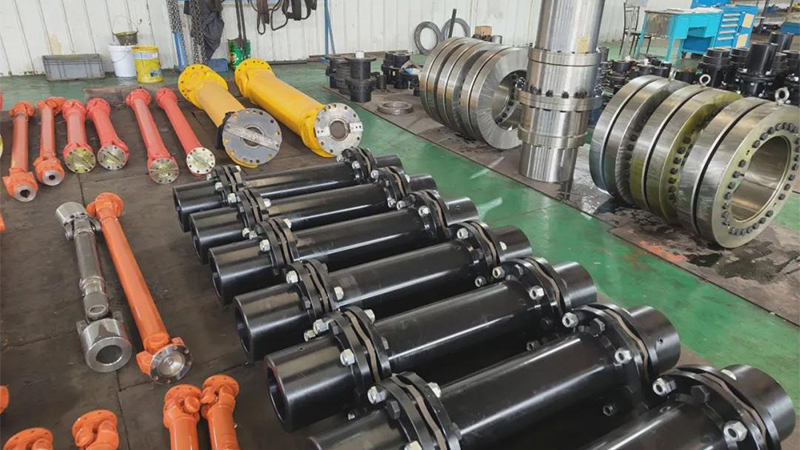
Universal shaft couplings take flexible transmission as their core advantage. They can realize stable power transmission between two shafts with large angular deviation, with a maximum angle of up to 45°, adapting to complex working conditions with limited space and large angle between two shafts. They have a solid structure, strong load-bearing capacity and excellent impact resistance, and can meet the continuous operation needs of heavy loads and alternating loads. They are widely used in construction machinery, agricultural equipment, metallurgical steel rolling equipment and other fields, such as excavators, cranes, tractors, etc., ensuring the stability and flexibility of power transmission.
Gear couplingsare the core choice for heavy-duty working conditions. Adopting a drum gear structure design, the tooth surface contact is uniform, the torque bearing capacity is large, it can effectively compensate for radial and angular deviations, with high transmission efficiency and reliable operation. They have outstanding wear resistance and impact resistance, and can adapt to harsh working environments in heavy industries such as metallurgy, mining and cement, such as crushers, ball mills, belt conveyors and other large equipment, effectively avoiding transmission failures caused by heavy loads and impacts, and ensuring the continuous and stable progress of production.
With their respective core advantages, various types of couplings cover the full-scenario needs from precision transmission to heavy-duty operation. They can not only improve equipment operation efficiency and reduce failure rates, but also greatly reduce equipment maintenance costs and downtime losses, providing solid support for the efficient, stable and safe operation of industrial production. With the acceleration of industrial intelligence and green transformation, the research and development of couplings is also moving towards the direction of high precision, long service life and low energy consumption, continuously empowering the upgrading of various industrial equipment and helping the high-quality development of the manufacturing industry.