


Industrial Couplings: Reliable Power Transmission for Heavy-Duty Machinery
Introduction to Industrial Couplings
Industrial couplings are essential mechanical components used to connect two rotating shafts and transmit torque between different parts of a machine. They play a critical role in maintaining stable power transmission, reducing vibration, accommodating shaft misalignment, and protecting connected equipment from excessive mechanical stress.
Couplings are widely used in steel production, mining, metallurgy, power generation, petrochemical processing, construction machinery, and other heavy industrial applications. As industrial equipment continues to develop toward higher loads, greater precision, and continuous operation, the demand for durable, reliable, and application-specific coupling solutions continues to grow.
Product Introduction: Different Types of Industrial Couplings
Different operating conditions require different coupling structures and performance characteristics. Common industrial coupling products include the following types.
Gear couplings are designed for high-torque transmission and demanding industrial environments. Their gear-tooth structure enables efficient power transmission while accommodating a certain degree of angular, radial, and axial misalignment. They are commonly used in steel mills, rolling mills, cranes, mining machinery, and other heavy-duty equipment.
Flexible couplings help compensate for shaft misalignment and absorb vibration and shock during operation. Depending on their design, they can improve transmission stability and reduce the impact of mechanical fluctuations on connected components. They are suitable for pumps, motors, compressors, and general industrial machinery.
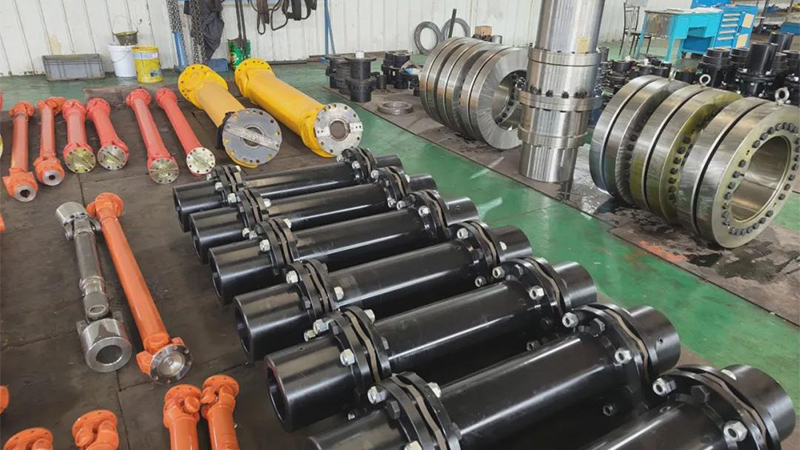
Rigid Couplings
Rigid couplings provide a firm connection between two accurately aligned shafts. They are suitable for applications where shaft alignment can be maintained and high torsional rigidity is required. Typical applications include precision machinery, industrial drive systems, and selected power transmission assemblies.
Custom Industrial Couplings
For specialized machinery and demanding operating environments, customized couplings can be manufactured according to customer drawings, dimensions, material requirements, and technical specifications. Custom solutions help ensure compatibility with existing equipment and specific installation conditions.
Manufacturing Processes and Quality Control
The performance of an industrial coupling depends on several factors, including material selection, structural design, manufacturing precision, and quality control.
Depending on the product design and application, manufacturing processes may include casting, forging, CNC machining, heat treatment, drilling, gear cutting, and surface finishing. Each process serves a different purpose, from establishing the basic component structure to improving dimensional accuracy, mechanical properties, and surface quality.
During production, critical dimensions, bore sizes, tooth profiles, concentricity, and other relevant specifications should be inspected according to the product's technical requirements. Appropriate material selection and heat treatment can also help improve wear resistance, strength, and service life under demanding operating conditions.
For industrial buyers, working with an experienced manufacturer that understands custom drawings and application requirements can help reduce compatibility issues and support more reliable equipment operation.
Applications Across Industrial Sectors
Industrial couplings are used in a wide range of mechanical transmission systems. In the metallurgical industry, they connect drive components in rolling mills and other heavy production equipment. In mining operations, they support power transmission in conveyors, crushers, and related machinery. In the energy sector, couplings are used in selected pump, compressor, generator, and turbine drive systems.
Their role extends beyond simply connecting two shafts. A properly selected coupling helps maintain transmission stability, accommodate operating conditions, and reduce unnecessary stress on connected equipment.
Conclusion
As industrial machinery becomes increasingly demanding, reliable coupling solutions remain essential for efficient and stable power transmission. From heavy-duty gear couplings to flexible and customized coupling products, the right design and manufacturing process can make a significant difference in equipment performance.
For manufacturers and industrial equipment buyers, selecting a coupling based on torque requirements, rotational speed, shaft dimensions, alignment conditions, operating environment, and installation space is an important step toward achieving long-term operational reliability.
If you require custom industrial couplings, provide your drawings, dimensions, material specifications, or application details to explore a suitable manufacturing solution for your project.